Monday, April 30, 2012

Great Music - La Folia 5


Sorry to my loyal readers for having missed a day yesterday.  But this is a new week, so we’ll start it out right by resuming the journey through the ages with the Spanish dance tune, La Folia.  Today’s Folia comes from perhaps the best known son of Johann Sebastian Bach, Carl Phillip Emmanuel Bach (or as he’s known in musical history, C.P.E. Bach.)


C.P.E., the child of J.S. Bach and his first wife, was born in 1714 (his godfather was the famous musician and composer, Georg Philip Telemann.)  He was one of four of the elder Bach’s numerous children to become a professional musician.  All of his formal training he received from his father.  In order to gain more prestige (musicians at that time, were treated like servants, for which the most part they were), C.P.E. also pursued a law degree in Leipzig and Frankfurt.  He received a degree in 1738, and turned immediately to music.  There is no indication that he ever used his law degree. 


After graduation, C.P.E., one of the best keyboardists in Europe, and backed by the formidable reputation of his father, secured a place in the court of the Crown Prince Frederick of Prussia (who ascended to the throne two years later and has come down to us in history as Frederick the Great.)  C.P.E.’s reputation continued to grow as he produced work after work during his thirty years at court.  He also wrote on musical subjects, and during these years produced Versuch über die wahre Art das Clavier zu spielen (An Essay on the True Art of Playing Keyboard Instruments), which for decades was the standard text for all keyboard players.

In 1768, C.P.E. succeeded his godfather, Telemann, as music director for the City of Hamburg.  In the next twenty years, music flowed from his pen, producing keyboard and orchestral works, religious music (including 21 settings of the Passion of Christ), and court music.  His reputation was supreme throughout Europe.  Mozart called hailed him as “the father, we are the children.”  Haydn and Beethoven also acknowledged C.P.E.’s genius; and after his death, he was studied by Carl Maria von Weber, Felix Mendelssohn and Johannes Brahms.  C.P.E. died in Hamburg in 1788.

Given his great historical reputation as a keyboardist, it is no surprise that C.P.E.’s contribution to the La Folia legacy comes in the form of keyboard variations.  Here, they are played on the harpsichord.  Enjoy!


Saturday, April 28, 2012

Great Music - La Folia 4

This has been my first week of bloging and I've learned one thing:  it's easier to do during the week than the week-end.  It's been a busy day, but I didn't want to leave my loyal readers without the next installment in our journey through the past three hundred years of the Spansih  dance tune, La Folia.  Today's composition is from the Italian composer Francesco Geminani.


Geminani comes  to La Folia naturally.  He was born in Lucca in 1687.  Geminani's musical ability was recognized early on and he studied under Alessandro Scarlatti (La Folia - Part 2).  Geminani was a violin prodigy and studied later under Archangelo Corelli (La Folia - Part 1).  Having learned his art at the hands of such illustrious masters, Geminani was ready at the tender age of 24 to assume the post of opera conductor in Naples.  He continued to produce much music, including concerti, operas and orehestral work, which spread his reputation throughout Europe.  In 1714, he went to England where he played his violin concerti with none other than George Friedrich Handel at the keyboard.  Geminani, well connected and acclaimed, continued to compose, travel and perform, right up to his death in 1762.

Geminani's La Folia comes in the form of a Concerto Grosso.  In a homage to his teacher, Corelli, Geminani arranged a set of Corelli's violin sonatas as orchestral works, including the D Minor La Folia sonata.  Enjoy!


Friday, April 27, 2012

Silent Film - Frankenstein 1910

When I shared the clip a few days ago of Edison Studios 1907 film of Christmas Carol, I referenced this short film of Frankenstein as well.  This, the very first film version of Mary Shelley's famous story, was made in 1910.  Although the name of Edison is always associated with this film, the great inventor actually had no direct involvement in the films produced by the studio that bore his name.  So it might better be titled J. Searle Dawley's Frankenstein, since he was the director.  This time, I do have a brief cast list for you:  Augustus Phillips is Dr. Frankenstein, Mary Fuller is his fiance, and Charles Ogle is the Monster.

This film again is a short one-reeler. As far as I can determine, this is only American film version of Frankenstein prior to the 1931 Boris Karloff classic.  Enjoy!


History Today - Samuel F. B. Morse - Accomplished Artist, Innovative Inventor and Unabashed Bigot

American has produced many great mean and women, but even more characters.  And when great accomplishment meets with strange eccentricity, it may not always be pretty, but it sure makes a great story.  Since today is Morse's 221st birthday, it seems like a good time to tell it.

Most of us know Samuel Morse as the inventor of the telegraph (Morse code, and all that); but he was also one of the most important American painters of antebellum era.  He was born in Charleston, Massachusetts in 1791, the son of famous Calvinist preacher, whose strict puritanical beliefs his son inherited.  Morse's talent for drawing and painting were evidenced at an early age; but his education was broad.  He attended Phillips Academy and Yale University, where he studied religion, philosophy, mathematics and the sciences (especially electricity).  Morse was not only a brilliant student (he graduated Phi Beta Kappa), but he supported his education through his painting.


In the early 1800s, most American artists of any note, spent time in Europe absorbing the culture and art museums, and studying under established masters.  Morse was no exception, and due to his talent, he was sent to London in 1811, where he studied under Washington Allston and Benjamin West.  He was admitted to the Royal Academy and was influenced by the neo-classical school and the work of Raphael and Michelangelo.  He first major work was the Dying Hercules.


Morse returned to the U.S. in 1815.  The next 15 years were to be productive for Morse as an artist, and he turned to American subjects as well.  Here is just a sampling of his work:

The aging John Adams:


President James Monroe:


The old Chamber of the House of Representatives:


In 1825, Morse was commissioned to do a full-length portrait of the Revolutionary hero, the Marquis de Lafayette, who was making a final tour of America:


In the 1830s, Paris was the center of the art world, and Morse went to Paris for additional study (there he became fast friends with the American author, James Fenimore Cooper, who was residing in Paris at the time.)  There he completed another masterpiece, The Gallery of the Louvre, which recreates over thirty masterpieces hanging in the museum.  It was a huge canvas (6 ft. x 9 ft.) and when he brought it back to America, this was the first chance many people had to see these masterworks:


Beginning in the 1830s, Morse became interested in electro-magnetic telegraphy after encountering the scientist, Charles Jackson, on a voyage back to America.  Morse watched Jackson's experiments (which were in turn, based on work done by Wilhelm Webber and Charles Grauss.)  Morse's simple, one wire system, improved this work and was superior to others experimenting at the time (although his life would be taken up with defending his system and patents against others.)


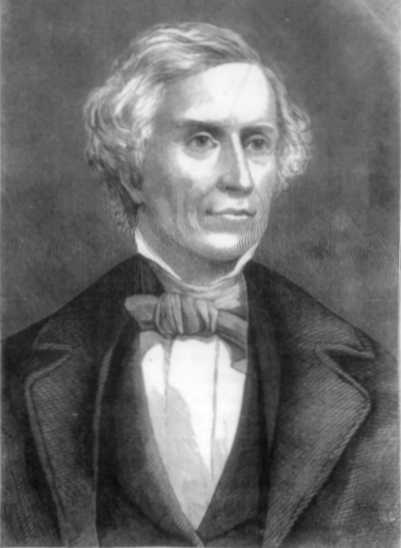
Morse secured patents throughout the 1830s and 1840s and spent nearly all his time defending them and his status as "Father of the Telegraph."  (Ironically, his invention was mad practical by the work of Leonard Gale, who figured out how to transmit the telegraph signals over long distances.)  He received federal support and foreign recognition (although the rest of the world seemed content to give him honors, but no royalties.  Here is a picture of Morse near the end of his life with all his medals.


The Great American Success Story, right?  No doubt - revered artist and inventor - and also one of the great racial and religious bigots of all time.  Morse accepted all the stereotypes of the African-American slaves of the time, writing, “My creed on the subject of slavery is short. Slavery per se is not sin. It is a social condition ordained from the beginning of the world for the wisest purposes, benevolent and disciplinary, by Divine Wisdom. The mere holding of slaves, therefore, is a condition having per se nothing of moral character in it, any more than the being a parent, or employer, or ruler.”

And it wasn't just blacks that Morse didn't like.  As he was making his trips to Europe in the 1830s and 1840s, hundreds of thousands of immigrants were coming the other way - to America.  The vast majority of these new immigrants were Catholic, which didn't sit well with the American Protestant culture in which Morse was raised.  He joined the anti-immigrant Nativist Party, even running for Mayor of New York in 1836 on the party ticket (he received a little over 1400 votes in a city whose population was several hundred thousand.)  The anti-catholic sentiment of the time is best expressed in Thomas Nast's famous cartoon, The American Ganges River:


Not content with trying to shut-down catholic schools and forbidding catholics to hold public office, Morse wrote an anti-catholic screed called Foreign Conspiracies Against American Liberties, in which he opined, “Surely American Protestants, freemen, have discernment enough to discover beneath them the cloven foot of this subtle foreign heresy. They will see that Popery is now, what it has ever been, a system of the darkest political intrigue and despotism, cloaking itself to avoid attack under the sacred name of religion. They will be deeply impressed with the truth, that Popery is a political as well as a religious system; that in this respect it differs totally from all other sects, from all other forms of religion in the country.”

Morse deserves credit for helping establish American art, and for the real revolution in communications his telegraph created.  But his extreme political views leave a stain on his historical record.  Maybe it would have been better if he had gone back to painting.

Great Music - La Folia 3


As we continue our traversal of the Spanish dance tune, La Folia, through the ages, I hope that the glorious music you’ve been hearing makes up for my brief, inadequate explanations.  I’m especially happy to share with you one of my two favorite Folia compositions:  Vivaldi’s Trio Sonata in D Minor.


Antonio Vivaldi was born in Venice in 1678.  He was baptized immediately after his birth, leading some to believe that his lifelong ill health was congenital.  His father was Giovanni Vivaldi, an accomplished violinist who was the young Antonio’s first teacher (Giovanni was prominent enough as a musician to have been the founder of a musical society under the patronage of St. Cecilia).  Antonio’s talent was immediately evident, and as a young child he gave concerts with his father in Venice.  The boy also studied composition under Giovanni Legrenzi, the maestro di cappella at St. Mark's Basilica.  From his youth, Vivaldi suffered from ill health (the accounts of which, have led some scholars to believe he suffered from severe asthma.)  His health, however, does not seem to have prevented his musical studies.

At the age of fifteen, Vivaldi’s life took another turn when he began studying for the priesthood.  He was ordained at twenty-five, but was very soon after relieved of most of his priestly duties, due to his health.  He remained a priest, however, for the rest of his life.  Vivaldi’s vocation, along with his hereditary red hair, led to his enduring nickname, the “Red Priest.”

His musical career flourished and in 1703, he became the violin master at an orphanage called the Pio Ospedale della Pietà (Devout Hospital of Mercy).  Vivaldi’s duties included teaching the orphans music and composition.  Many of his famous concertos were written to showcase the talents of himself and his pupils.  He also composed a good deal of religious music.  Vivaldi’s reputation spread throughout Europe, especially as composer of violin music (his own technique was masterful and ground-breaking).  He also enjoyed some success as an opera composer and his works were staged in Venice, Florence and Vienna.


In 1717, Vivaldi accepted the prestigious post of Maestro di Cappella in Mantua.  It was during this period that he composed his most famous work, The Four Seasons, a quartet of virtuoso violin concertos, depicting each of the seasons of the year.  As he got older, Vivaldi’s music fell out of favor as the Classical époque overtook the Baroque.  Vivaldi died in 1741 in Vienna.  Vivaldi was the subject of renewed interest (although his greatest music was never out of the repertoire) in the late 19th and early 20th centuries, which secured his place as one of the great composers.

Vivaldi’s Trio Sonata is for two violins and basso continuo.  Like most Folia compositions, it is a set of variations, which uses Corelli’s Sonata as its touchstone.  But in Vivaldi’s hands, it all becomes new and exciting.  Take note of the variation that begins at 6:45, although the tempo is a little fast here, it is one of those miniature gems that will melt your heart, full of beauty and longing.  Enjoy!